Dál Riata – The Ancient Realm of the Liminal Paths
At the dawn of legend, the river valleys of the highlands rang with iron and song. Amid fires of craft and kinship, early foundations were laid. Food was salted against the long seasons and skills in pottery and metalwork were honed with care, shaping tools and vessels of strength and quiet grace. These were the works of those who endured, binding land and labour to memory.
Far to the west beyond the edges of the known world, the wars of the Tuatha Dé Danann stirred. Their struggles, wrought with powers beyond mortal grasp, would in time pass into story. Yet something of them remained, pressing faintly upon the world.
In time, those of the highlands – warriors, craftsmen and seers – turned their gaze outwards. Whether by memory or by a pull not wholly their own, they looked beyond their homeland towards the western isles.
Undaunted by storm or sea, they set out. Their ships, shaped from timber and bound with skill, crossed narrow waters beneath the setting sun. They carried with them strength, craft and tongue. They made landfall upon the island called Pretani, and from there pressed onwards – through marsh and forest, through hills where the land seemed to watch in silence.
Some of the host came to mystic mountains where shimmering lakes nestled beneath slopes holding reflections that did not always answer the sky. In such places the boundary between what is seen and what is not grew thin. There the druids, learned in earth and star, spoke of what lay beyond that threshold and foretold that the journey was not yet ended.
Beyond those lands lay Ériu, the sacred isle. When they came upon it, it was veiled – clouded and shifting. The Tuatha Dé Danann were not seen as they once had been, yet their presence endured in the land beyond the deception.
The newcomers circled the island, seeking a way ashore. The clouds above it were said to take strange forms as though living things moved across the sky. Along the shores, figures gathered – watching, measuring. Three queens came forth to meet them, sovereign and unyielding, bearing the will of the land itself.
What followed passed into the telling of ages. War came as it must when one world presses upon another. In the end the newcomers prevailed. The Tuatha Dé Danann withdrew into the hidden places, becoming the aos sídhe, whose presence would linger in hollow hill and shadowed ground.
The victors came to be known as the Milesians and Ériu became their home.
Generations passed. Settlements spread across wood and river across hills where the wind carried echoes of older things. Yet the sídhe were not forgotten. At times they were glimpsed at the edge of sight. At others they made themselves known in ways less easily borne – through illness, mischance or the quiet unmaking of what had seemed secure. The balance between worlds was never wholly settled.
As their numbers grew, some among the Milesians looked again to the sea. Drawn by need or by something less easily named, they crossed the waters once more – northward over the Sea of Moyle, returning to the lands their forebears had once touched.
The northern reaches of Pretani were not empty. There dwelt painted warriors whose signs were cut into stone and whose presence lingered in glen and hill. Their monuments stood not merely as markers, but as voices set into the earth, carrying thought beyond the span of a single life.
These lands held fast to what had come before. The past lay close, carried in stone, in story and in the shifting light upon the hills.
Into this ground came new kindreds, bearing their own line and claim. Among the strands of their descent lay a link to Conaire the Great, a king whose name carried both sovereignty and burden. From his line came Cairpre Riata, from whom a portion of these kindreds would take its name.
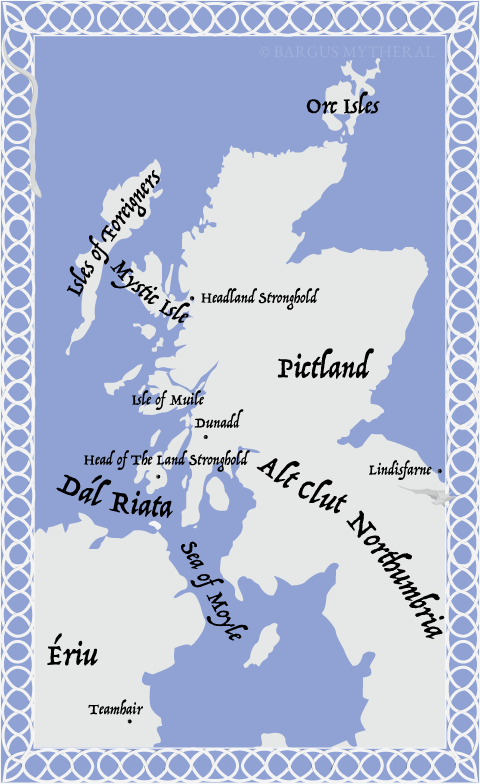
Through crossings of sea and the taking of land their domains came to stretch across both shores – between the northern reaches of Ériu and the western coasts of Pretani. These were known as Dál Riata, the portion of Riata, a name that bound them to inheritance and division alike.
Their shaping was not left wholly to memory. The monk Bede wrote of a kindred who came from Ériu under a leader named Reuda, understood to be Riata, and who made their place in those northern lands, whether by pact or by force. He records that their name was taken from this leader and that dál signified a share.
Other reckonings remain. The Senchus fer nAlban sets down their divisions, naming kindreds and territories, and the dues owed by each. It tells of service in war, and of ships kept for the crossing of the sea – two seven-benched vessels for every twenty households. From this it is known that the sea was no boundary to them, but a road oft taken.
At their heart stood Dunadd, set upon rock, where kings were made and rule was held.
Yet even here, the older currents endured. The land, shaped by what had passed through it, did not yield entirely to the new. Stories remained – of waters that were not still, of forms that shifted, of beings who crossed between worlds as others crossed between shores.
Named after Riata, this realm stands between Ériu and Pretani, between what is remembered and what is half-lost. Its paths run over sea and through shadow alike.
Much of Dál Riata lies veiled. Its beginnings are not set in a single telling, but in many, layered one upon another. Yet it endures – as a crossing of ways, a meeting of kindreds and a ground upon which further memory is laid.